He Wanted to Protest a Fishing Law. He Got a Country Instead.
The Paperwork That Shouldn't Have Gone Through
Most people, when they get angry at a government regulation, write a strongly worded letter. Maybe they call their congressman. If they're feeling dramatic, they leave a one-star review on a federal agency's website.
Roy Bates built a country.
The year was 1967. The location was a rusted World War II anti-aircraft platform sitting in the North Sea, seven miles off the coast of England. The man was a former British army major turned pirate radio broadcaster who had already spent years thumbing his nose at maritime law. And the argument he was about to start—with the British government, with international maritime bodies, and eventually with the entire concept of sovereign statehood—is one of the genuinely strangest legal stories the twentieth century produced.
Bates didn't set out to become a head of state. He set out to find a broadcast location outside British territorial waters so he could run his radio station without a license. What he found, instead, was a loophole big enough to park a nation inside.
A Platform With No Owner and No Country
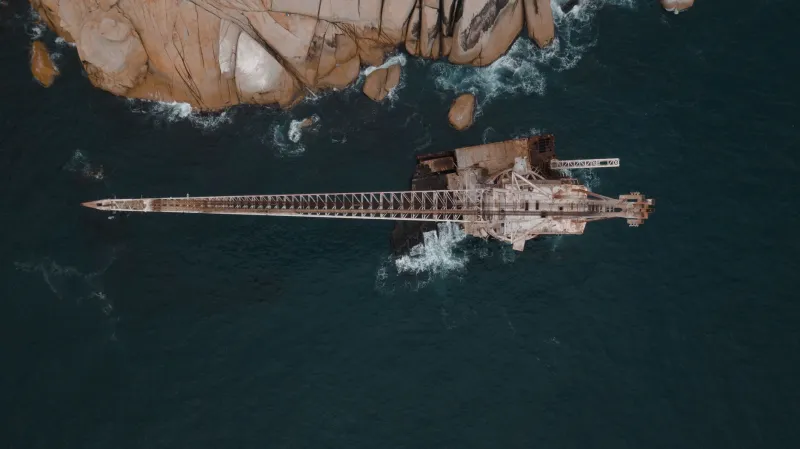
Roughs Tower—the structure Bates eventually claimed—had been built by the British military during World War II as a sea fort, one of several constructed in international waters to provide anti-aircraft coverage during the Blitz. After the war ended, the military abandoned them. By the 1960s, they had become a favorite haunt of pirate radio operators, who recognized immediately that a structure outside territorial waters was also outside broadcast regulations.
When Bates occupied Roughs Tower in September 1967 and declared it the Principality of Sealand, he was betting on a specific legal gap: the platform sat outside the three-mile limit that defined British territorial waters at the time. Britain's government, he argued, had no jurisdiction over what he did there.
The British government disagreed. Then a British court ruled on the matter—and to almost everyone's astonishment, the court essentially agreed with Bates. A 1968 ruling found that the crown had no jurisdiction over events occurring on the platform. The judge, by most accounts, looked deeply unhappy delivering this conclusion, but the law was the law.
Roy Bates had, accidentally and through sheer stubborn paperwork, carved out a space that British law couldn't touch.
The Flag, the Passports, and the Inevitable Chaos
Here's where the story pivots from legal curiosity to genuine absurdity.
Bates didn't stop at occupying the platform. He wrote a constitution. He designed a flag—red, white, and black, with a diagonal stripe that looks vaguely like someone tried to design a country crest in an afternoon, which is essentially what happened. He established a nobility system, making his wife Princess Joan and himself Prince Roy. He printed passports.
The passports are where things got really complicated.
Sealand passports were never officially recognized by any legitimate government. But they were real documents, printed and distributed, and in the chaotic gray zones of international travel and commerce, "real-looking document from an unrecognized nation" turns out to be a phrase with dangerous potential. Over the following decades, Sealand passports showed up in fraud investigations across three continents. A criminal network in the 1990s reportedly obtained tens of thousands of blank Sealand passports and used them in identity fraud schemes spanning multiple countries.
Bates disavowed the fraud operation. He also had to disavow a coup attempt—an actual, literal coup attempt in 1978, when a German businessman who had been granted Sealand citizenship decided he wanted to run the place himself and hired mercenaries to seize it while Bates was away. Bates flew back, retook the platform with the help of his son, and held the German businessman as a prisoner of war—arguing that since Sealand was a sovereign nation, standard prisoner-of-war protocols applied.
Germany sent a diplomat to negotiate his release.
A German diplomat. To a rusty platform in the North Sea. To negotiate with a former British army major who had declared himself a prince.
The Nation That Refused to Go Away
Sealand's legal status has never been formally resolved. International law scholars treat it as a fascinating edge case—a structure that doesn't quite meet the Montevideo Convention's requirements for statehood (it has no permanent population to speak of, and its "territory" is a platform) but also exists in a space where no government has successfully asserted jurisdiction over it.
Britain eventually extended its territorial waters to twelve miles, which technically swallowed Sealand's location. Bates disputed this on the grounds that Sealand's sovereignty predated the extension. The British government's response to this argument was, essentially, to pretend Sealand didn't exist and hope it went away.
It hasn't. Roy Bates died in 2012, but Sealand continues to be administered by his family. It has a website. It sells noble titles. It has a national soccer team that competes in the CONIFA World Football Cup, the tournament for nations that FIFA won't touch. As of this writing, you can purchase a Sealand lordship for about thirty dollars.
Why One Man's Temper Tantrum Became Legal History
The Sealand story gets cited in international law courses not because it's a successful model of anything, but because it exposes the seams in how statehood actually works. Nations exist, in large part, because other nations agree they exist. When that consensus breaks down—or when someone finds a gap in the agreement—the results are stranger than fiction.
Roy Bates didn't want a country. He wanted to play music on the radio without paying for a license. The bureaucratic machinery he stumbled into gave him something far more complicated, and far more ridiculous, than he bargained for.
Somewhere on a rusted platform in the North Sea, the Principality of Sealand is still, technically, open for business.