The Cow That Never Kicked the Lantern: How a Reporter's Deadline Lie Burned a Family for 125 Years
The Cow That Never Kicked the Lantern: How a Reporter's Deadline Lie Burned a Family for 125 Years
On the night of October 8, 1871, a fire broke out in the DeKoven Street neighborhood of Chicago's Near West Side. What followed was catastrophic. Over the next two days, the blaze consumed more than three square miles of the city, killed an estimated 300 people, destroyed roughly 17,000 structures, and left somewhere around 100,000 Chicagoans — nearly a third of the city's population — without homes. It remains one of the most destructive urban disasters in American history.
And for more than a century, an Irish immigrant woman and her cow took the blame for all of it.
The story you probably know goes like this: Catherine O'Leary, a working-class woman who kept a small dairy operation behind her home on DeKoven Street, went out to milk her cow late that evening. The cow, startled or ornery, kicked over a kerosene lantern. The lantern ignited the hay. The hay ignited the barn. The barn ignited Chicago.
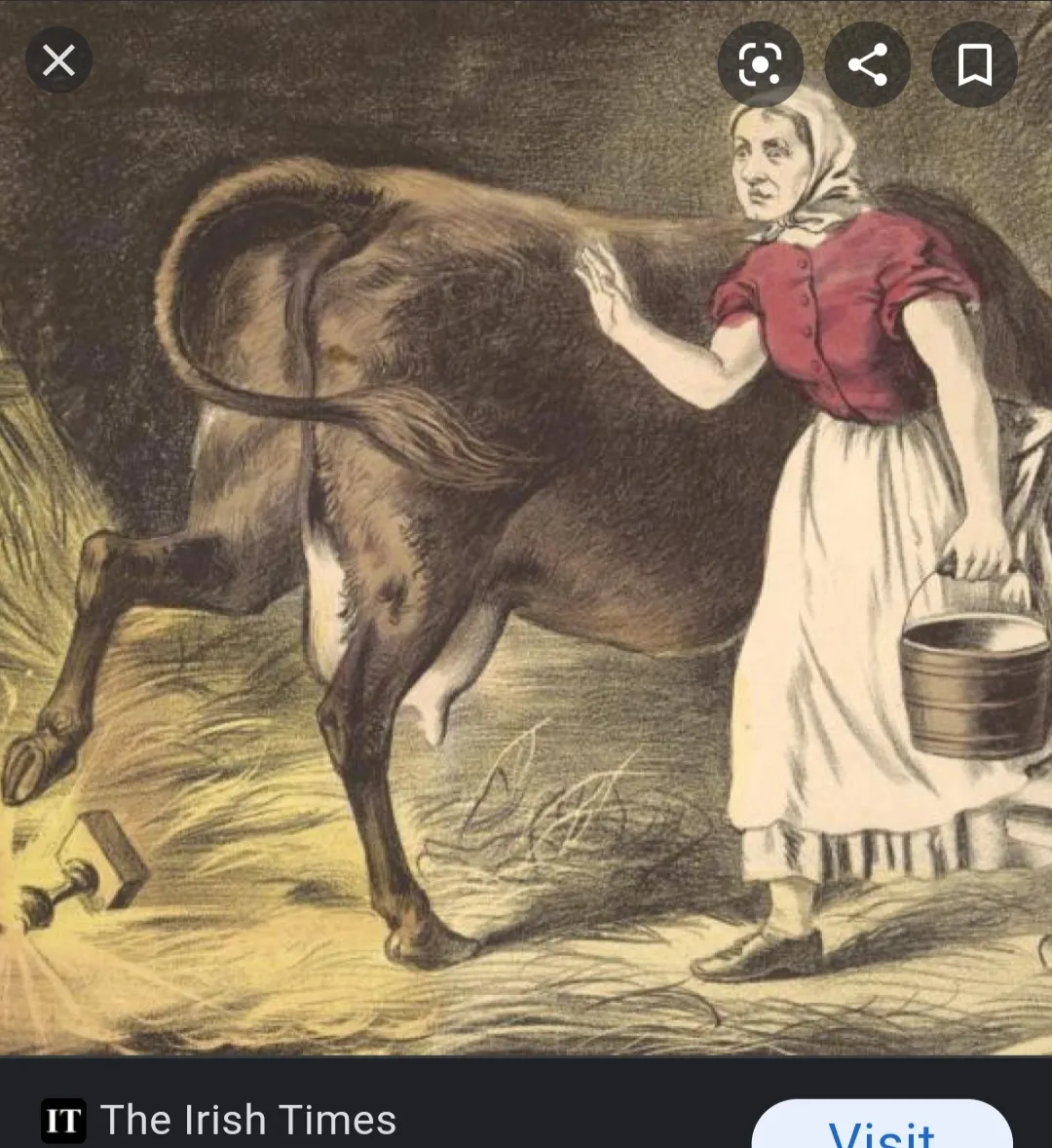 Photo: Catherine O'Leary, via theexasperatedhistorian.com
It's a vivid story. It's a satisfying story. It has a clear cause, a sympathetic setting, and a specific villain — or at least a specific clumsy animal. There's just one significant issue with it.
Almost none of it appears to be true.
The Man Who Invented the Cow
The lantern-and-cow story first appeared in print just days after the fire, in the pages of the Chicago Evening Journal. The reporter responsible was a man named Michael Ahern, and by his own admission — made decades later, in 1893 — he had fabricated the detail about the cow and the lantern entirely. He needed a colorful explanation for a chaotic event, he was working against a deadline, and the image of a cow kicking over a lantern in the dark was just too good to leave out.
It's worth pausing on that for a moment. A reporter made up a detail. The detail became the explanation. The explanation became the legend. And the legend destroyed a real family's life for over a century.
Catherine O'Leary and her husband Patrick were subjected to immediate and sustained public hatred. The fire investigation that followed the disaster did place the origin point in or near the O'Leary barn, which was real. But the investigators were never able to determine exactly how or why the fire started, and the cow story was never corroborated by a single credible witness. Catherine O'Leary herself denied it emphatically and repeatedly until her death in 1895. Nobody believed her.
The Anatomy of a Scapegoat
It's hard to read the history of how the O'Leary family was treated without noticing the role that anti-Irish and anti-immigrant sentiment played in making the story so easy to believe and so hard to dislodge.
In 1871, Chicago had a large and often marginalized Irish immigrant population. The O'Learys were working-class Catholics in a city where that combination made you a convenient target for suspicion. The image of a careless Irish woman and her unruly cow torching a great American city fit neatly into existing prejudices. It required no evidence. It just required an audience willing to find it plausible.
Catherine O'Leary became a national symbol of recklessness. She was caricatured in newspapers, mocked in songs, and treated as a figure of public scorn for the rest of her life. She reportedly became so distressed by the attention that she rarely left her home in her final years. Her children grew up in the shadow of a story their mother never stopped denying.
Meanwhile, other theories about the fire's true origin floated quietly at the margins. Some historians pointed to Daniel Sullivan, a neighbor who claimed to have spotted the fire first and whose account contained several inconsistencies. Others suggested the fire may have been started by a group of men gambling in the barn that night. A more recent and genuinely fascinating hypothesis, proposed by amateur astronomer Robert Wood in 2004, suggested that fragments from Biela's Comet — which had been breaking apart in the years prior — may have showered the Midwest with flammable debris on the same night, potentially explaining why multiple major fires broke out simultaneously across the region, including the Peshtigo fire in Wisconsin that killed far more people than the Chicago blaze but receives a fraction of the historical attention.
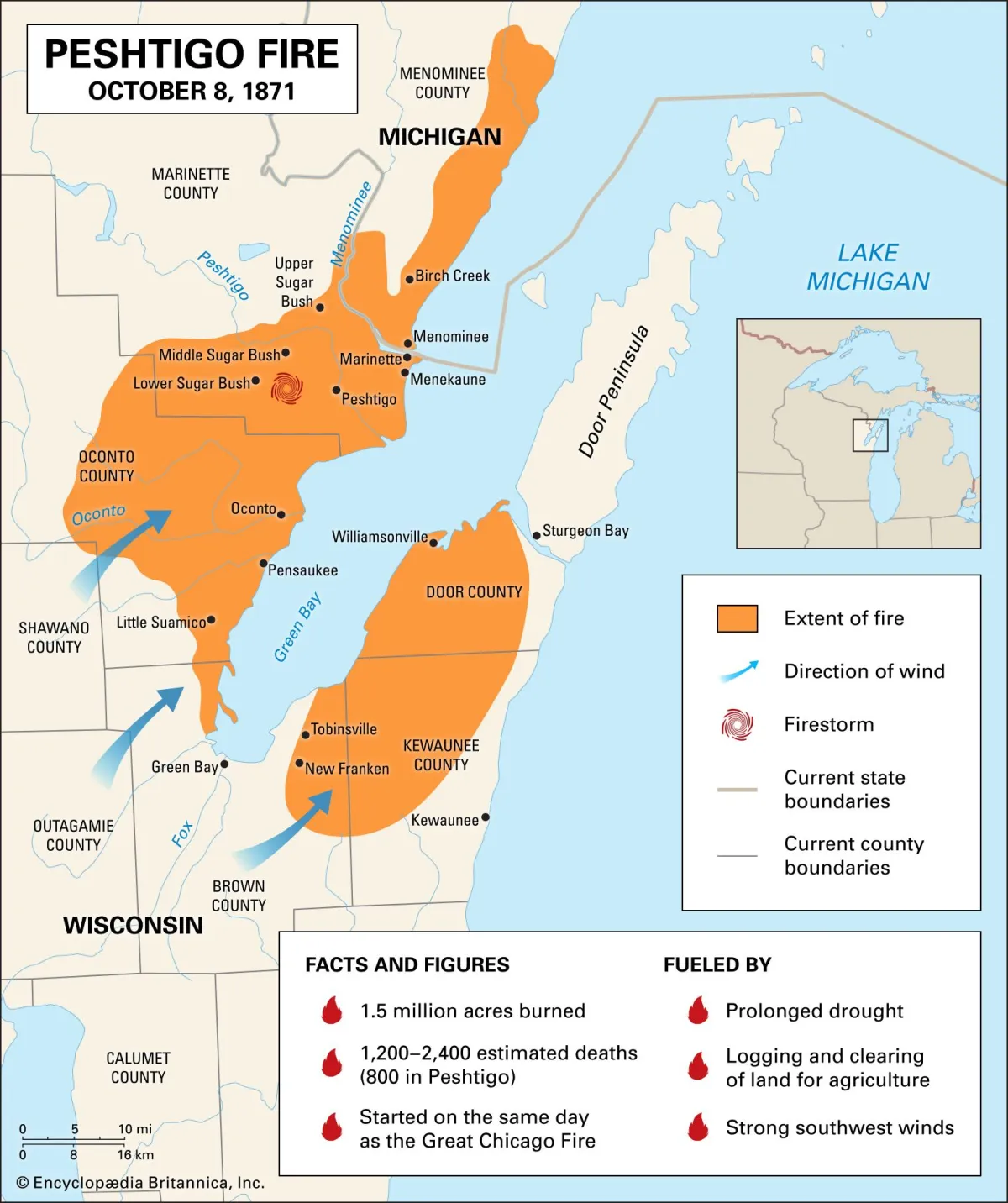 Photo: Peshtigo fire, via cdn.britannica.com
None of these theories have been definitively proven. But none of them are less credible than a cow with a lantern.
126 Years Later, an Official Apology
In 1997, the Chicago City Council passed a resolution officially exonerating Catherine O'Leary and her cow. Alderman Edward Burke, who championed the resolution, noted that the original story had been a fabrication and that the O'Leary family had suffered unjustly for more than a century based on a reporter's invention.
It was a remarkable moment — a city formally apologizing to a woman who had been dead for over a hundred years, on behalf of a press corps that had long since moved on, for a story that had never been true.
The resolution didn't change history, of course. The cow-and-lantern story remains the version most Americans learn. It appears in children's books and documentaries and casual conversation. It has the stubborn immortality of a great story that arrived before the facts did.
Why This Story Refuses to Die
There's something genuinely unsettling about the Chicago Fire myth, and it has nothing to do with cows or lanterns. It's about how quickly a made-up detail can become historical fact, and how slowly — if ever — a correction follows.
Michael Ahern wrote a colorful sentence on a deadline in October 1871. That sentence outlived him. It outlived Catherine O'Leary. It outlived everyone who knew the truth. It took a formal act of government to push back against it, and even that barely dented the popular narrative.
The O'Leary family suffered real consequences — social isolation, public hatred, and generational shame — because one man needed a good story and didn't let the absence of evidence slow him down.
The fire was real. The destruction was real. The grief was real.
The cow? The cow was always fiction.