The Government Built a Perfect Little American Suburb—Then Used It for Target Practice
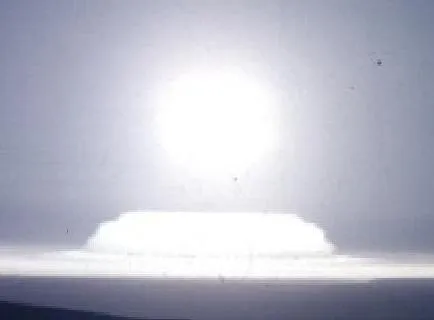
Photo: Правительство США, Public domain, via Wikimedia Commons
In the middle of the Nevada desert, during the 1950s, the federal government built a town that was never meant to be lived in. It had houses. It had cars. It had kitchens stocked with canned food and living rooms arranged for family photos. It also had mannequins posed as parents and children, waiting for a nuclear blast to arrive.
The site became known as Doom Town, and it remains one of the strangest domestic experiments in American history. It was a suburb built for destruction, a stage set designed to answer a very practical Cold War question: if the bomb came, what would happen to the everyday stuff of American life?
Why Build a Town Just to Blow It Up?
By the early 1950s, the Cold War had turned atomic anxiety into a growth industry. The Soviet Union had tested its own atomic bomb in 1949. American cities were running air-raid drills. Schoolchildren were practicing duck-and-cover. The federal government wanted to know what a nuclear weapon would actually do to houses, power lines, cars, and people—or at least to the objects people stood behind.
The Nevada Test Site was already hosting above-ground nuclear tests. Officials decided to make some of those tests more realistic by constructing full-scale suburban structures near ground zero. The project involved the Federal Civil Defense Administration and a small army of builders, engineers, and photographers. The point was not just military data. It was public messaging. The government wanted to show Americans that civil defense was serious, and that survivability might depend on preparation.
The Uncanny Details of a Fake Neighborhood
The town was meticulously ordinary. Houses were built with different materials and methods so researchers could compare how brick, wood, and other construction held up. Interiors were furnished. Kitchens had appliances. Living rooms had sofas. There were cars in the driveways and power lines overhead. Mannequins stood in for residents, dressed in everyday clothes and placed in domestic poses.
That last detail is what makes the photos so unsettling. A mannequin in a kitchen is not a person, but it is close enough to trigger the imagination. Newsreels showed the fake families arranged in their fake homes, and viewers understood exactly what the experiment was implying. The houses were stand-ins for real neighborhoods. The mannequins were stand-ins for real people.
The Tests and What They Revealed
The most famous of these experiments was Operation Cue in 1955, which included a test that exposed the town to a nuclear blast. The results were a mix of the expected and the disturbing. Some structures were destroyed. Some were damaged but left standing. Fire, blast pressure, and radiation all played a role. The mannequins, of course, did not survive in any meaningful sense, and the images of their scorched and disheveled forms became some of the most memorable artifacts of the era.
But the tests also revealed the limits of the exercise. A desert test site is not a city. Single-family homes are not apartment buildings. A mannequin is not a human being with lungs, fear, or a basement to hide in. The experiments produced useful engineering data, but they could also create a false sense of confidence. If a house survived the blast, did that mean its occupants would have survived too? Not necessarily.
The Message and the Merchandise
Doom Town was never just a scientific project. It was also a piece of theater. The government wanted the public to take civil defense seriously, and the images from the Nevada desert were designed to be seen. They appeared in newsreels and newspapers. They helped sell the idea of fallout shelters, evacuation routes, and preparedness drills.
At the same time, the spectacle was hard to ignore. A fake suburb destroyed by a real weapon was a strange kind of entertainment. It blurred the line between research and public relations, between warning people and frightening them. The town was both a laboratory and a warning sign, and it worked on both levels.
The Afterlife of a Fake Town
The original Doom Town is gone, and the Nevada Test Site is now part of a restricted federal reservation. But the photographs remain. They show neat little houses with neat little rooms, all waiting for the end of the world. The ordinariness is the point. The government was not testing whether a military bunker could survive. It was testing whether the American home could.
That is what makes Doom Town so oddly haunting. It was a suburb built to be destroyed, a neighborhood with no residents, a family photo with no family. It was also a serious attempt to understand a threat that felt very real at the time. The result is a slice of Americana that is equal parts engineering experiment, propaganda, and dark comedy.
The strangest part is not that the government built a fake town and blew it up. The strangest part is how much it looked like home.