They Were Digging for Parking Spaces. They Found a Lost City Instead.
Most great archaeological discoveries have a certain romance to them. The determined scholar. The remote desert. The painstaking brushwork revealing something ancient and extraordinary. What they don't usually involve is a backhoe operator stopping mid-scoop because his bucket just punched through the roof of a prehistoric storage chamber.
But that's roughly what happened in the American Southwest when a perfectly ordinary infrastructure project — the kind that gets approved at city council meetings nobody attends — accidentally tore the lid off one of the most significant archaeological finds in recent regional history. The builders were expecting bedrock and fill dirt. What they got was a civilization.
The Most Boring Kind of Project
The project in question was exactly as unglamorous as it sounds: a municipal parking structure expansion in a mid-sized Southwestern city. The site had been assessed, permits had been pulled, and the environmental review had flagged nothing of particular concern. The area wasn't known for significant pre-contact occupation. Previous surface surveys had turned up the occasional potsherd — enough to note, not enough to stop anything.
Construction began on schedule. Then, at roughly twelve feet below grade, the excavation equipment started hitting things it shouldn't have.
At first, the crew thought they'd found old utility infrastructure — maybe a buried cistern or a forgotten basement from an earlier building. The foreman called a halt and brought in a site supervisor. The site supervisor looked at what the bucket had exposed and called the city. The city called the state historic preservation office. The state historic preservation office called archaeologists. And the archaeologists, when they arrived and started looking at what was actually down there, got very quiet in the way that professionals get quiet when they realize something significant is happening.
What Was Down There
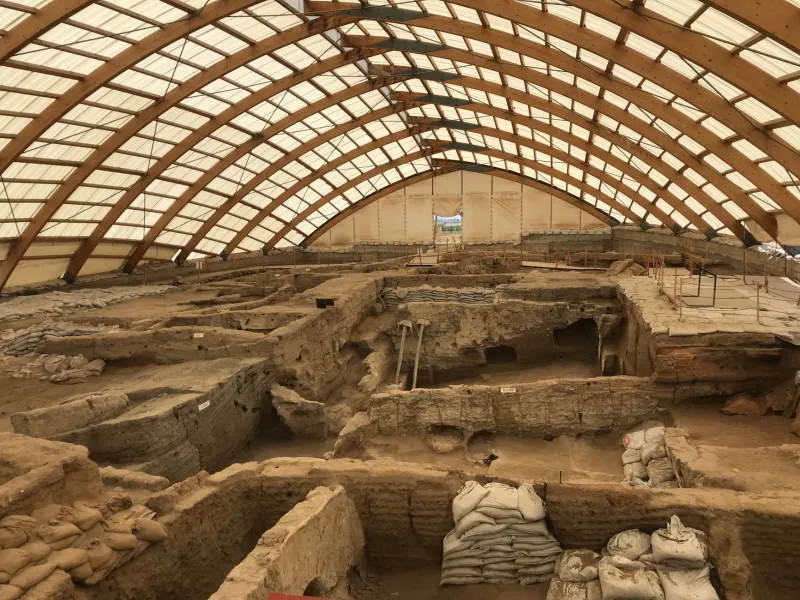
What the excavation had broken into was the edge of a substantial ancient settlement — not a campsite, not a seasonal shelter, but a genuine community with defined architectural spaces, evidence of long-term occupation, and a material culture that told a complex story about the people who had lived there.
The site included the remains of multiple pit structures — semi-subterranean dwellings that were a hallmark of early Ancestral Puebloan occupation in the region — along with storage features, evidence of agricultural activity, and a ceramic assemblage that spanned several distinct time periods. The occupation layers suggested the site had been inhabited, abandoned, reoccupied, and modified over a stretch of several centuries.
What made this genuinely startling to archaeologists wasn't just the size of the site — it was the location. The settlement sat in an area that existing models of pre-contact occupation had essentially written off as a marginal zone, too far from known water sources and too exposed to have supported a stable community of any significant scale. The people who built this place had apparently found ways to make it work that researchers hadn't anticipated.
Why Nobody Had Found It
The question everyone asked was obvious: how had this stayed hidden?
The answer turned out to be a combination of factors, each mundane on its own but collectively effective at keeping the site invisible for generations of surface survey. First, the settlement had been built substantially below the original ground surface — the pit structure design that defined it meant that almost nothing projected upward in a way that would have been visible. Second, centuries of alluvial deposition had buried it under nearly a dozen feet of accumulated sediment, effectively sealing it from the kind of casual surface inspection that flags most sites. Third, the area had been developed incrementally over the twentieth century in ways that disturbed the uppermost soil layers just enough to scatter surface artifacts without ever penetrating deep enough to hit the primary occupation levels.
The site had been hiding in plain sight — or rather, hiding in plain asphalt — for decades.
Rewriting the Textbooks
The archaeological work that followed the discovery took years. The parking structure project was redesigned at considerable expense to preserve the most significant portions of the site, and a full excavation of the exposed areas produced thousands of artifacts, extensive architectural documentation, and a set of radiocarbon dates that pushed the known occupation of the region back by several centuries.
For researchers working on questions of how and when ancient communities expanded into marginal environments, the site was transformative. It demonstrated that the people of this period were more adaptable, more mobile, and more willing to experiment with challenging landscapes than the existing record had suggested. In academic terms, it was a significant find. In plain terms, it meant that a lot of what was written in textbooks about who lived in this part of North America, and when, needed to be revised.
The Accidental Archaeologist
The construction foreman who called the halt that day — the one who looked into the hole and decided something wasn't right — reportedly said afterward that he'd had a feeling something was off from the moment the bucket started pulling up unusual soil. He'd worked enough sites to know that dirt doesn't always feel like dirt when there's something in it.
He wasn't an archaeologist. He wasn't looking for anything. He was just paying attention.
Sometimes that's all it takes to find a lost civilization.