America Once Studied Detonating a Nuke on the Moon for Morale. The Moon Got Lucky.
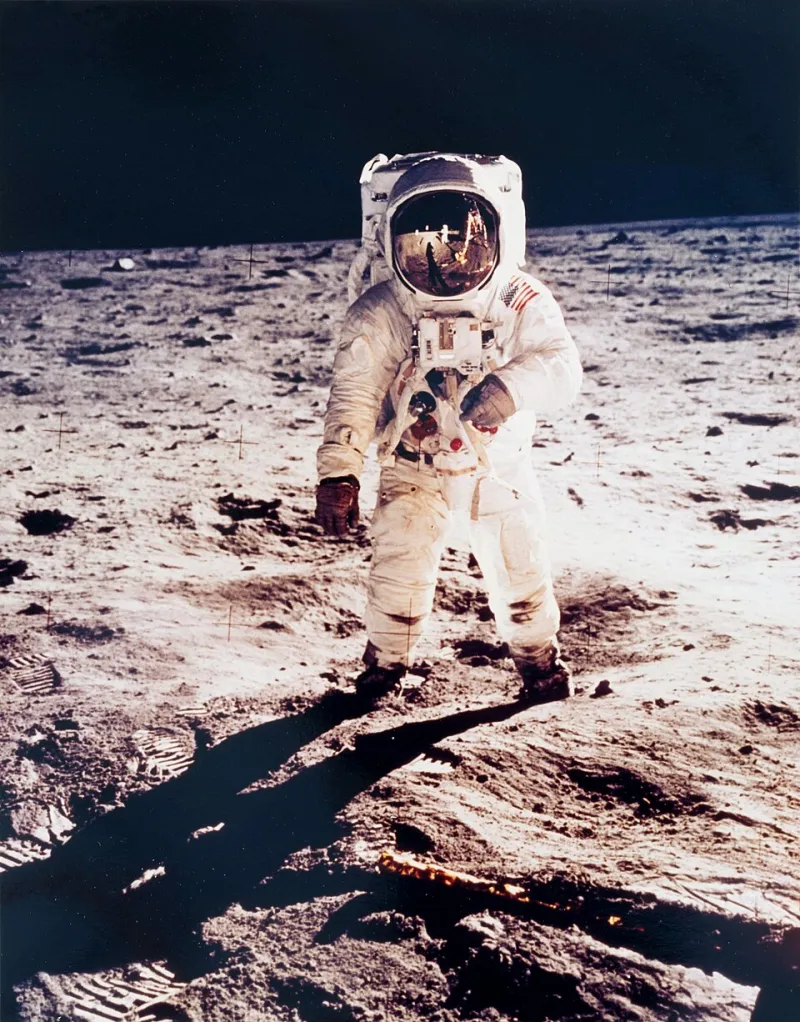
Photo: Neil Armstrong / NASA, Public domain, via Wikimedia Commons
Before Neil Armstrong took his small step, before Apollo became a national crusade, a small group of American scientists studied a very different kind of lunar mission. They considered sending a nuclear bomb to the moon and detonating it. The idea was not to destroy the moon. It was not to test a weapon in secret. It was, at least in part, to put on a show.
The project was called A119. It was a secret study conducted in the late 1950s, when the United States was reeling from the Soviet Union’s launch of Sputnik. The Soviets had put a satellite in orbit. America had not. The space race had begun, and the United States was looking for a way to make a dramatic statement. A nuclear flash on the moon would certainly be dramatic.
A Study Nobody Was Supposed to See
Project A119 was not a CIA operation. It was a U.S. Air Force study, carried out with the Armour Research Foundation at the Illinois Institute of Technology. The effort was led by physicist Leonard Reiffel. A young Carl Sagan, then a graduate student, was involved in mathematical modeling related to the project. The study was classified, and for decades it remained out of public view.
Reiffel later disclosed the project’s existence in 2000, and the basic outline became public. The plan was not an operational order. It was a feasibility study, a what-if exercise conducted by people who were trying to understand whether a lunar nuclear detonation could be done and whether it would be useful. The answer to the first question was probably yes. The answer to the second was murkier.
The Public Relations Logic of a Lunar Flash
The Cold War was not just a contest of weapons. It was a contest of confidence. Each side wanted to show the world that its system was more advanced, more capable, and more inevitable. Sputnik was a propaganda victory for the Soviet Union. The United States needed a counterpunch.
A nuclear explosion on the moon had a certain crude logic. The moon is visible to everyone. A bright flash on its surface would be seen, or at least detected, by people on Earth. It would be a reminder that American rockets could reach the moon and American technology could do something extraordinary. It would be impossible to ignore.
The plan was not about military advantage in any conventional sense. There was no enemy base on the moon. There was no lunar territory to capture. The value was in the spectacle. A nuclear detonation would be a message written across the sky, paid for by the American taxpayer and delivered by the American space program.
The Physics of a Very Strange Firework
The moon has no atmosphere, so a nuclear explosion there would not produce the familiar mushroom cloud. There would be a flash, a burst of radiation, and a cloud of lunar dust thrown outward. The visible effects would be different from an Earth-bound detonation, but they could still be dramatic. The study looked at questions like the size of the explosion, the visibility of the flash, and the behavior of the dust.
There were also scientific arguments. A nuclear blast could create seismic signals that might reveal something about the moon’s interior. It could throw up material for study. But the scientific value was questionable, especially when compared with the risks. The moon was not a test range. It was a shared object in the sky, and contaminating it with radioactive debris would have been a public relations problem of its own.
Why the Plan Died
Project A119 was abandoned before it became anything more than a study. The reasons were practical and political. A rocket carrying a nuclear weapon to the moon could fail. It could explode on the launch pad. It could scatter radioactive material in the atmosphere. It could provoke an international outcry. And it could hand the Soviet Union a propaganda victory if the United States were seen to be weaponizing space.
There was also the simple fact that the moon shot was already becoming a bigger idea. The United States was moving toward a human spaceflight program. The goal of putting a man on the moon was more ambitious, more inspiring, and less likely to be condemned as a stunt. A nuclear explosion on the moon might have produced a headline. A human footprint would produce a legacy.
The Strangest Fireworks Display That Never Happened
Today, Project A119 is a reminder of how strange the Cold War could be. The same era that produced fallout shelters and missile crises also produced a study about detonating a nuclear bomb on the moon for morale. It sounds like science fiction, but the paperwork was real. The scientists were real. The calculations were real. The plan just never left the study phase.
That is probably for the best. The moon has been hit by asteroids, blasted by solar wind, and covered in dust for billions of years. It did not need a nuclear bomb. But the story remains a fascinating glimpse into a moment when the United States was willing to consider almost anything to prove it was still in the game.
In the end, the most unbelievable part is not that someone thought of the idea. It is that serious people studied it, weighed the odds, and then decided not to do it. The moon, silent and distant, never knew how close it came to becoming the strangest fireworks display in human history.