The Phantom Island That Fooled the World for a Century
The Island That Never Was
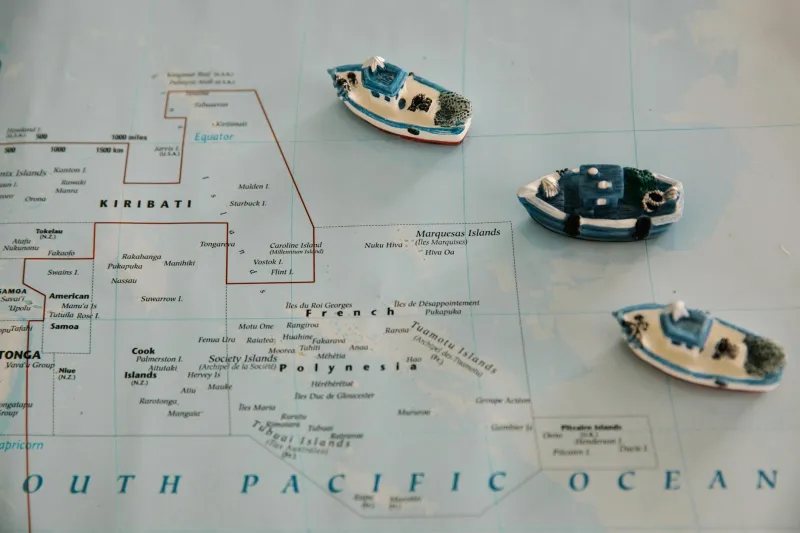
In November 2012, a team of Australian scientists aboard the research vessel Southern Surveyor set course for Sandy Island, a landmass roughly the size of Manhattan located in the Coral Sea between Australia and New Caledonia. According to their charts — and Google Earth, and the Times Atlas of the World — they should have found a substantial piece of land at coordinates 19°15′S 159°56′E.
 Photo: Times Atlas of the World, via m.media-amazon.com
 Photo: Coral Sea, via www.visitsealife.com
Instead, they found 4,600 feet of empty ocean.
The crew dropped a weighted line expecting to hit sandy beaches. It kept dropping until it reached the seafloor, nearly a mile below where solid ground was supposed to exist. They had just debunked one of cartography's longest-running hoaxes, a phantom island that had fooled mapmakers, governments, and satellite imaging systems for more than a century.
How to Hide an Island in Plain Sight
The story of Sandy Island reads like a masterclass in how misinformation spreads through authoritative sources. The island first appeared on British Admiralty charts in 1876, marked as "Sandy I." — likely based on a sighting report from the whaling ship Velocity. In an era when vast stretches of the Pacific remained unexplored, such reports were taken at face value and dutifully recorded.
What happened next demonstrates the dangerous feedback loop of authoritative copying. One map referenced another, which referenced another, each iteration lending credibility to the last. The French hydrographic service picked up the island from British charts. The Times Atlas included it in their definitive world maps. By the digital age, Sandy Island had achieved something close to cartographic immortality.
Google Earth, that modern arbiter of geographic truth, confidently displayed Sandy Island as a dark landmass surrounded by coral reef. Zoom in close enough, and you could almost imagine beaches and vegetation. The satellite imagery looked convincing because our brains are remarkably good at seeing patterns where none exist — especially when we expect to see something.
The Mapmaker's Dilemma
The persistence of Sandy Island reveals a fundamental problem in how we create and maintain geographic knowledge. Cartographers face an impossible choice: include every reported landmass and risk perpetuating errors, or exclude unconfirmed features and risk omitting real discoveries.
For most of human history, they chose inclusion. Better to mark a questionable island than to leave sailors unprepared for unexpected land. This cautious approach made sense when maps were primarily navigational tools, but it also meant that errors, once established, became incredibly difficult to correct.
Sandy Island survived so long partly because it was positioned in one of the most remote corners of the Pacific. Unlike phantom islands closer to shipping lanes, which would have been quickly debunked by passing vessels, Sandy Island sat in splendid isolation, visited by virtually no one.
The Digital Age Makes Everything Worse
You might think that satellite imagery would have solved the phantom island problem once and for all. If Google's satellites can read your license plate from space, surely they can determine whether a Manhattan-sized island exists, right?
Wrong. The area around Sandy Island's supposed location is frequently shrouded in clouds, making clear satellite photography difficult. More importantly, early digital mapping systems often filled data gaps by referencing existing charts — the same charts that had been copying Sandy Island's existence for decades.
Google Earth's representation of Sandy Island wasn't based on satellite photography at all, but on a combination of bathymetric data (underwater topography) and traditional chart information. The system essentially drew what it expected to see based on historical records, creating a convincing but entirely fictional landmass.
A Proud Tradition of Imaginary Places
Sandy Island joins a long and distinguished list of phantom islands that have cluttered maps throughout history. The Atlantic Ocean was once crowded with imaginary landmasses: Brasil Island (not to be confused with Brazil), Hy-Brasil, the Island of Demons, and Frisland, among others.
Some phantom islands originated from genuine mistakes — mirages, clouds mistaken for land, or miscalculated positions. Others were deliberate fabrications, added by mapmakers as copyright traps or by explorers seeking to inflate their achievements. A few were simply wishful thinking, like the various attempts to locate Atlantis or other legendary lands.
What made Sandy Island particularly remarkable was its longevity in the modern era. While most phantom islands were eliminated from maps by the early 20th century, Sandy Island persisted well into the digital age, protected by its remote location and the self-reinforcing nature of cartographic authority.
The Great Unveiling
The 2012 expedition that finally debunked Sandy Island was led by Dr. Maria Seton from the University of Sydney. Her team wasn't specifically hunting for phantom islands — they were conducting geological surveys of the Coral Sea. Sandy Island was supposed to be a convenient landmark for their research.
 Photo: University of Sydney, via www.world-guides.com
When they arrived at the coordinates and found empty ocean, the crew's first assumption was that their GPS was malfunctioning. Only after multiple position checks did they realize they had stumbled onto something much more interesting than their original research project.
News of Sandy Island's non-existence spread quickly through the scientific community and then to major media outlets. Google Earth quietly removed the island from their maps. The Times Atlas issued corrections. Within months, a landmass that had existed on official charts for 136 years vanished from the geographic record.
What We Learned From an Island That Never Was
The Sandy Island affair offers several uncomfortable lessons about how we construct and maintain knowledge in the modern world. First, authoritative sources aren't immune to error — they're just better at perpetuating their mistakes across time and platforms.
Second, the digital age hasn't eliminated the fundamental problems of information verification; it's just made them faster and more widespread. A single error can now propagate across millions of devices and databases in a matter of hours.
Finally, Sandy Island reminds us that even in an age of satellite imagery and GPS precision, vast portions of our planet remain genuinely unexplored. The ocean depths that the Southern Surveyor measured beneath Sandy Island's supposed location had never been properly charted. In trying to debunk one mystery, the scientists discovered another: the actual seafloor topography of a region that had been hidden beneath a phantom island for over a century.
The Islands We Haven't Found Yet
Today, cartographers continue to grapple with questionable landmasses scattered across the world's most remote waters. Some may be real islands that have simply never been properly verified. Others are likely phantoms, waiting for someone to sail to their coordinates and find empty ocean.
Sandy Island's debunking didn't end the age of phantom geography — it just reminded us that in a world where we can order pizza from space, there are still blank spots on the map waiting to surprise us. Sometimes the most unbelievable thing about reality is discovering what parts of it were never real at all.